
Ibrahim Mahama invites CATPC to exhibit at Fondation Cartier
On 22 October, The Harvest Season opens at Fondation Cartier pour l’art contemporain in Paris. Ibrahim Mahama has invited CATPC (Cercle d’Art des Travailleurs de Plantation Congolaise) to participate in the exhibition, alongside eight other artists and collectives with whom he has developed collaborations and exchanges over the years.
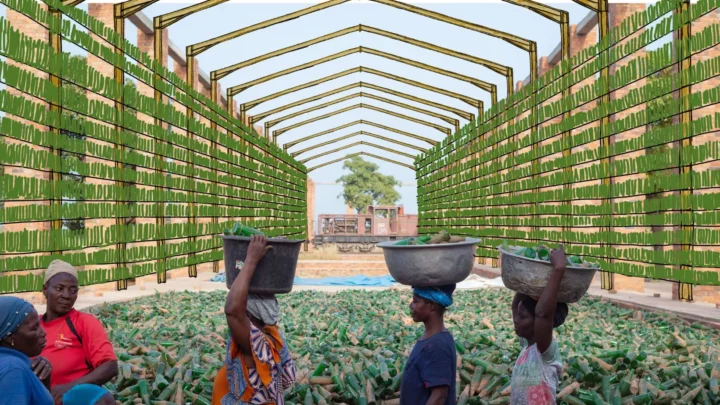
Ibrahim Mahama, The Harvest Season
In The Harvest Season, Mahama brings together artists and collectives whose practices are rooted in the histories of labour, colonialism and the movement of goods and materials. The exhibition also reflects his interest in the role art can play beyond the museum, particularly in creating opportunities for education, cultural exchange and community development.
Read more about The Harvest Season.
The CATPC Collection
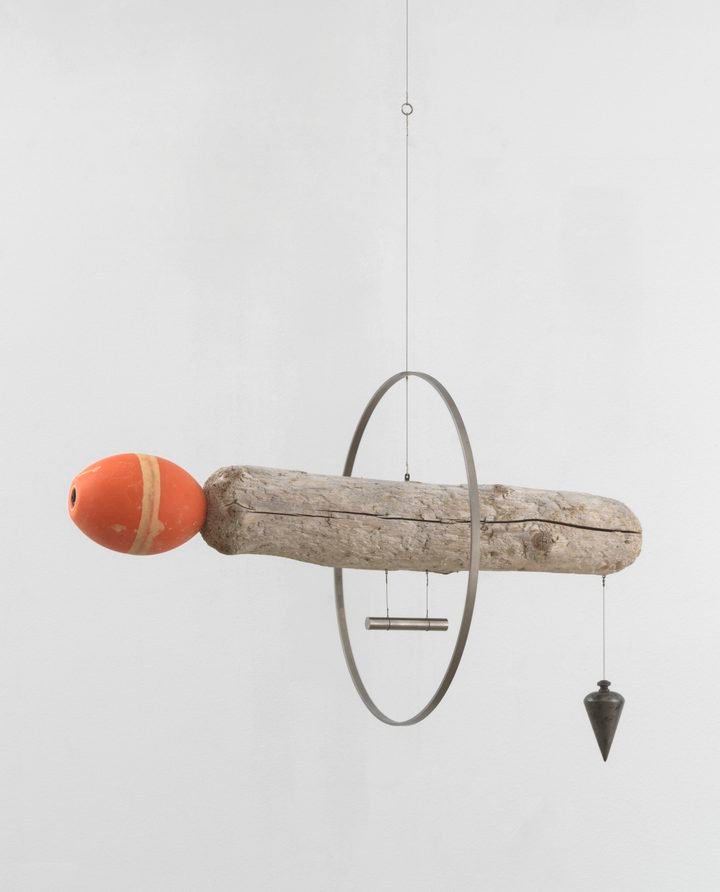
Olafur Eliasson
Shore compass (10:00, orange)
Driftwood, plastic, stainless steel, magnet, wire
49 x 68 x 34 cm
Photo: Jens Ziehe
© 2018 Olafur Eliasson
The CATPC Collection is the first international art collection collectively owned by a community of plantation workers. Based in Lusanga, Democratic Republic of Congo, the collection brings together works by artists from around the world and connects their cultural and economic value to CATPC’s ongoing work to reclaim and reforest former plantation land.
The inaugural collection includes works by Francis Alÿs, Ai Weiwei, Jan Dibbets, Marlene Dumas, Olafur Eliasson, Sandra Mujinga, Lydia Ourahmane, Chéri Samba, Christopher Kulendran Thomas and Luc Tuymans. Each year, new artists will be invited to contribute to the collection.
The collection remains in the collective ownership of CATPC and will have its permanent home at CATPC’s White Cube in Lusanga, designed by OMA.
From art to land
For more than a decade, CATPC has used the proceeds from its art to buy back former plantation land in Lusanga. Approximately 400 hectares have now been reclaimed and are being reforested and cultivated through regenerative agriculture.
The CATPC Collection extends this approach: artists from around the world contribute works to a collection collectively owned by CATPC, connecting the value and visibility of international art to the continued reclamation and reforestation of the land.
“Until now, our own art has helped us to reforest the land; now artists from across the world are joining us. The Sacred Forest will be one big collective work, co-authored by all these artists.”
— Ced’art Tamasala and Matthieu Kasiama, CATPC
Reversing the flow of value
The collection proposes a reversal of a historical relationship. Wealth generated through plantation labour in Congo and elsewhere contributed to the accumulation of capital and the development of cultural institutions and collections in Europe, while the communities producing that wealth were left with depleted land and little control over the value they generated.
CATPC is now building and owning a collection of its own. The works in the CATPC Collection are not intended for private circulation or sale. They form a permanent collection held collectively in Lusanga. Their cultural and economic value strengthens CATPC’s ability to continue reclaiming and restoring former plantation land.
The collection is therefore not simply about bringing international art to Lusanga. It changes the direction in which cultural value moves, connecting the international art world to the reforestation of the land from which CATPC’s history cannot be separated.
As Marlene Dumas says of her contribution to the collection:
“We can no longer undo Lumumba’s murder, nor can we erase the sins of our fathers, but it is wonderful that works of art can now help to restore the forest.”
A collection for a forest
At the centre of CATPC’s work is the return of the forest. Approximately 400 hectares have already been bought back through the proceeds of CATPC’s artistic practice. Former plantation land is being restored through reforestation and regenerative agriculture. For CATPC, the return of the forest represents not only ecological recovery, but also the recovery of a cultural and spiritual landscape profoundly altered by plantation monoculture.
The relationship between the collection and this process is visualised in a large-scale drawing by CATPC artist Ced’art Tamasala. The work maps connections between the CATPC Collection, the international art world, histories of extraction and the forest returning in Lusanga.
Each work entering the collection becomes part of this larger process: art held in common, connected to land held and restored by the community.
“Once these works enter the CATPC Collection, they become part of something bigger, something held in common, owned by our community and connected to the land we are reforesting. Our movement has always been about creating another way of living and working together, and today we are finding solidarity among artists across the world. This collection makes that solidarity tangible, and gives us another way to work together towards the future of the planet.”
— Ced’art Tamasala and Matthieu Kasiama, CATPC
The CATPC Collection is supported by Human Activities in Amsterdam.
Het Land van Hagelslag. Samen bouwen aan een nieuwe wereld
22 May – 8 November 2026
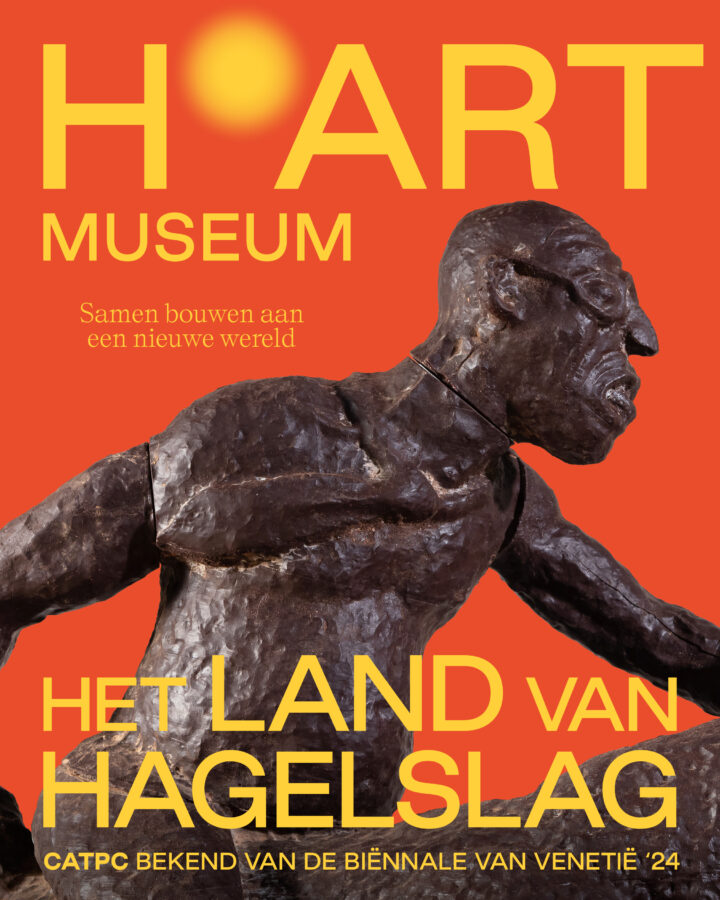
Hagelslag seems like an everyday product for many people, but it has a darker side: cacao, sugar, and palm oil are often produced on plantations where both people and nature pay a heavy price. The profits from those plantations flowed back to Europe, where they helped build the art museums we visit today.
This spring, H’ART Museum in Amsterdam presents Het Land van Hagelslag. Samen Bouwen aan een nieuwe wereld (The Land of Hagelslag. Building a new world together), opening Friday, 22 May 2026. At the center of this exhibition is Congolese artist collective CATPC, who makes art to expose and reverse this system. Two years ago they represented the Netherlands at the Venice Biennale, curated by Hicham Khalidi and Dutch artist Renzo Martens, where their cacao and palm fat sculptures attracted significant attention. With the proceeds from their sold works, CATPC buys back exhausted plantation land to plant food forests. This way they establish food security, biodiversity, and the restoration of their sacred forest.
The exhibition features 30 chocolate sculptures and a series of embroidered works. Originally modelled in clay and cast in cacao, palm oil, and sugar using 3D technology, each sculpture tells its own story of exploitation, inequality, and resistance. The embroidered works depict portraits of resistance fighters and plantation workers from Congo, Haiti, Suriname, Indonesia, and Ghana, stitched onto the very burlap sacks used to transport cacao around the world. Together, they form a tribute to a shared struggle against colonial exploitation.
At the heart of the exhibition stands the Kinzonzi — a communal work table where visitors are invited to shape their own response to the work of CATPC. How do land and people find balance again, and how do we build a new world together?
Het Land van Hagelslag. Samen Bouwen aan een nieuwe wereld will be on view through Sunday, 8 November 2026. Tickets and more information are available via H’ART Museum.
ArtReview: CATPC nominates Kopiisme
CATPC nominates Kopiisme for Art Review’s article series Future Greats. CATPC visited the community in Indonesia in 2024, to discuss how museums “choose to interrogate their role in the world with handpicked curators, researchers or artists, but seem to avoid engaging with the very people on the plantations who funded and still sustain them.”
“Pak Sa’i asked CATPC to submit an offering of coffee to the Stedelijk Museum and invited them to reach out to him and his community. The offering was presented to the Stedelijk Museum director in a public event in November 2024. A year later, they have yet to reach out.”
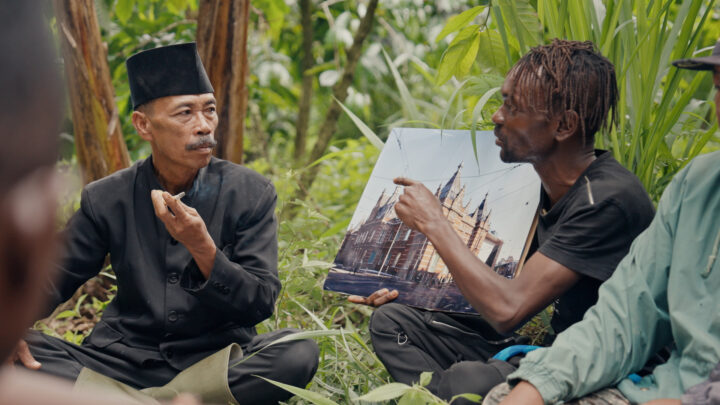
Pak Sai’i and Ced’art Tamasala (from left). Photo: Brahmantyo Puta. Copyright: Scenery / CATPC / Human Activities.
Want to know more about CATPC’s visit to Indonesia? Take a look at the film that Human Activities and CATPC made on their visit to the Kopiisme community.
Leren, Graven, Bouwen in Terneuzen
On a field in the Netherlands, Human Activities has taken the first steps toward establishing White Cube Zeeuws-Vlaanderen, a new art center dedicated to the articulation of the art and culture of rural communities. The master plan for White Cube Zeeuws-Vlaanderen is being developed through co creation with the local community, in collaboration with architect David Gianotten (OMA).
As part of these co-creation sessions, students from the Lodewijk College in Terneuzen participated in the project week Leren, Graven, Bouwen (Learn, Dig, Build). Through a series of workshops guided by Human Activities and professional artists-educators, students learned new techniques while digging into the history of their land, and exploring the needs and possibilities for the future of the Zeeuws-Vlaanderen region. Their artworks expressed these reflections and considered the role of the future White Cube Zeeuws-Vlaanderen.
On 18 December 2025, the exhibition, fully created and curated by the students, opened to the public in Nesse, with guided tours held on 19, 20 and 21 December 2025. Leren, Graven, Bouwen is one in a series of co-creation sessions that are central for thedevelopment of the upcoming art center.
CATPC in ArtReview’s Art Power 100
Human Activities congratulates CATPC on its consecutive nomination to the yearly Art Power 100 list, ArtReview’s annual portrait of the most influential individuals and groups in the artworld. At last, communities that work and live on the plantations that have funded the establishment of key western art museums are starting to be recognized. ArtReview cites CATPC among initiatives that “are reinventing how their work should be distributed and who their audience should be, and who consciously plug the economics (which is to say the wealth) of the artworld into quite different social contexts.”
CATPC: “We express our gratitude to God and our ancestors for this renewed inclusion, which we dedicate to all plantation communities around the world. We are happy that through this recognition by ArtReview Magazine, we can continue to share the “unhealthy privileges” of art, transcend the colonial divide, and support each other in a spirit of solidarity. We dedicate and share this victory with all plantation workers. Especially those in Congo, Indonesia, Suriname, the Caribbean islands, and elsewhere in the world who, through forced labor, have involuntarily contributed to the existence of museums in the West. We also want to express our gratitude and joy for all the inspiration that brother Ibrahim Mahama has brought us. This collective achievement is proof that together, anything is possible.”
CATPC hosts “Learn, Dig, Build” conference at K21 in Düsseldorf
In the framework of the exhibition Land and Soil. How We Live Together, on view until 19 April 2026 at K21 in Düsseldorf, Germany, CATPC hosts the conference Learn, Dig, Build.
The conference centers CATPC’s position as a community of plantation workers. Speaking from various lived experiences, they reflect together with the most forward-thinking artists of this generation on their work with land, NFTs, and regeneration, and on how their perspectives may resonate with or amplify the regenerative practices of CATPC.
Program:
Saturday, 29 November, 11:30 — Learn
CATPC in conversation with: Johannes Büttner, Renzo Martens, and Alex Wissel.
Saturday, 29 November, 12:00 — Dig
CATPC in conversation with: Havîn Al-Sîndy, Nir Evron, and Christopher Kulendran Thomas.
Saturday, 29 November, 12:50 — Build
CATPC in conversation with: Simon Denny, Paul Kolling (terra0), and JP Raether.
The conference is hosted by CATPC and Kolja Reichert, Chief Curator of K21. It is developed as a collaboration between K21, CATPC, and Human Activities and is supported by the Mondriaan Fund.
Launches Toolkit: Seven Easy Steps for Museums to Liberate the Plantations that Funded Them
Today at the Wereldmuseum Amsterdam, CATPC launches Seven Easy Steps for Museums to Liberate the Plantations that Funded Them. In seven clear steps, this toolkit creates a framework for museums which have profited from the plantation economy to move beyond symbolic gestures toward genuine repair with plantation communities.
The toolkit is presented by Matthieu Kasiama, Mbuku Kimpala, and Ced’art Tamasala from CATPC in a keynote presentation at the Wereldmuseum Amsterdam during a seminar for museum professionals entitled HERE: Heritage Reflections. The event is focused on restitution and is initiated by the Mondriaan Fund, the public fund for visual arts and cultural heritage in the Netherlands.
Developed by CATPC and Human Activities, this toolkit draws from the perspectives of plantation worker communities and Western art institutions to help museums rethink their origins, responsibilities, and futures. It is especially designed to guide museums built with profits extracted from plantation worker communities.
The short handout version of the toolkit can be downloaded here. The full version can be accessed here.

CATPC at one of the plantation that funded the Stedelijk Museum, 2024, 6’32”. (still)
Exhibition “Echoes of a Day” at the White Cube in Lusanga
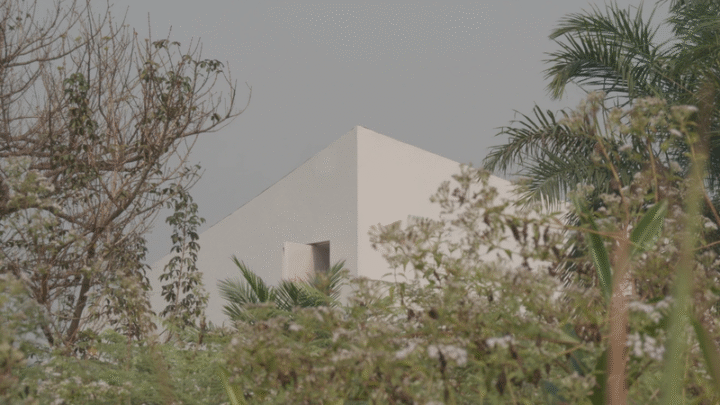
White Cube in Lusanga
On Tuesday 9 September 2025, at 15:00 CET, the exhibition “Echoes of a Day” will festively open at the White Cube in Lusanga, Congo, through a live video connection with Terneuzen, The Netherlands. It will run until 21 September 2025 and can also be visited online at whitecube.online.
For this exhibition, students of the Lodewijks College created works as part of a long-term collaboration with Human Activities. The students from Terneuzen met the members of the Congolese collective CATPC and drew on these discussions, linking them to their own experiences. Over the year, the students have been discovering how a community in Lusanga has reclaimed their land through art and started making works themselves.
The collaboration between Lodewijk College and Human Activities will continue in the future. Human Activities is developing a new art platform together with the people of Zeeuws-Vlaanderen in the Netherlands. The students of Lodewijk College are involved in all phases of the construction of this White Cube. This new art platform will work according to the same principle as in Lusanga: art enables the community to take back control of its history, land, and future.
The project is part of Human Activities’ program LEARN, DIG, BUILD, which is made possible by Mondriaan Fonds, Fonds21, Gieskes-Strijbis Fund, the municipality of Terneuzen, and the province of Zeeland.
In Memoriam: Derk Sauer
We are deeply saddened by the sudden passing of our beloved chairman, Derk Sauer
His leadership and inspiration have been invaluable to Human Activities. In his role as chairman, he was deeply involved, in good times and bad, both practically and morally. With Derk, we were able to achieve things that would not have been possible otherwise. He was a smart, strong, and loyal friend to us all.
We are grateful that he dedicated himself to us and our mission — to redress inequality through art. His enthusiasm, decisiveness, passion, and loyalty will continue to inspire us on our journey.
Derk will remain in our hearts forever.
We wish his loved ones strength as they cope with this profound loss.
On behalf of the board and team of Human Activities,
Janke Brands and Renzo Martens

Photo credits: Derk gives a speech at breakfast for Human Activities and CATPC at Harry’s Bar, Venice, 2024.
Ced’art Tamasala (CATPC) speaks at AFIELD Forum in Brussels

Photo credits: Ced’art Tamasala at the launch of CATPC’s educational program Cercle Luyalu, 2022. Photo: Ephraim Baku.
The AFIELD Forum: Transitional Justice by Artists is a three-day conference in Brussels that centers artists who contribute to the mechanisms of transitional justice. On Wednesday, 28 May at 16:30 in Globe Aroma, Ced’art Tamasala will speak for CATPC with Renzo Martens (Human Activities) and François Makanga in a panel that bridges two entwined geographies: a former Unilever plantation in the village of Lusanga, deep in DR Congo, and Brussels, a city whose wealth and identity are inseparable from its colonial past. The conversation explores these respective «sites» — the plantation and the city — and how their decolonial practice subverts and reclaims cultural institutions as arenas of contestation and restitution.
New series of Women’s Workshops in Lusanga

Photo credits: Eléonore Héllio
Currently, the second edition of CATPC’s Women’s Workshop is taking place in Lusanga. CATPC’s Women’s Workshop gives women who are usually only able to work on plantations, the chance to express themselves through making art. The women get acquainted with painting, sculpture and performance (including music). Additionally they learn about regeneratieve forestry. Meals are shared daily, grounding the work in care and community.
Festive Opening Two Sides of the Same Coin – CATPC solo show at the Van Abbemuseum

Photo credits: Boudewijn Bollmann
CATPC’s solo show at the Van Abbemuseum, titled Two Sides of the Same Coin, opens Saturday 21 December 2024. The festive opening event will take place on 18 January 2025. During this event, you can visit the exhibition for free all day and attend a special programme.

Photo credits: Peter Tijhuis
Screening and Talk at MACBA / Dart Festival, Barcelona
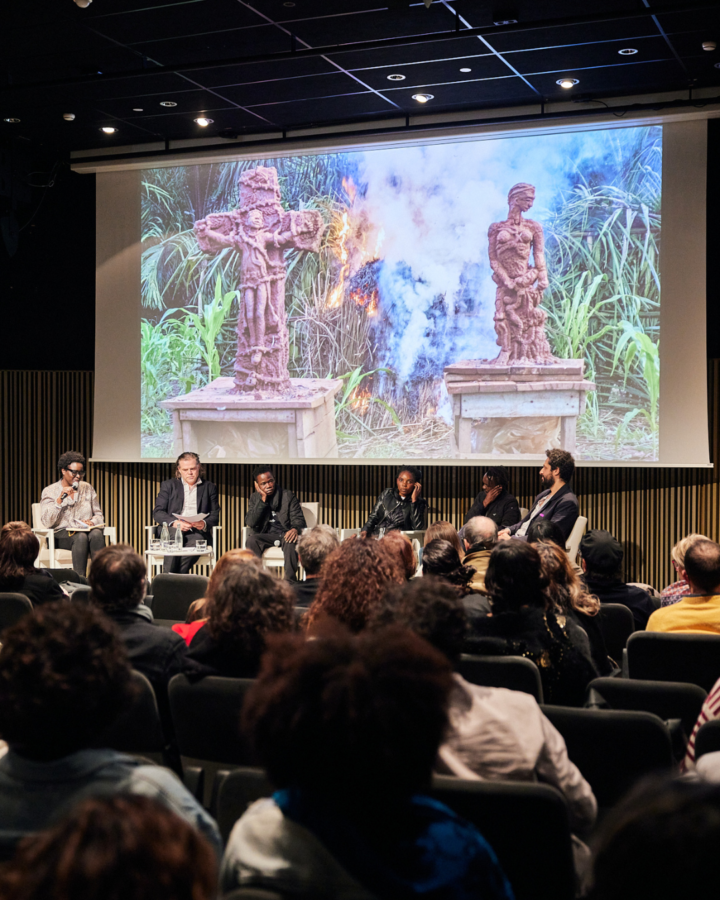
Photo credits: Leafhopper
As part of the DART Festival and in collaboration with MACBA, this event on 4 December explores the relationship between art and activism through the project presented by artist Renzo Martens and the Congolese artist collective CATPC at the 2024 Venice Biennale. The session includes the screening of three short films by the collective, followed by a discussion with Mbuku Kimpala, Ced’art Tamasala and Matthieu Kasiama (members of CATPC), Renzo Martens, and Hicham Khalidi, moderated by Elvira Dyangani Ose, Director of MACBA.
The event starts at 7 PM.
More info: here.
Bathtub Lecture Stedelijk Museum Amsterdam
During the third Bathtub Lecture on 30 November, artists Renzo Martens and Ced’art Tamasala will outline a shared future for the Stedelijk in which the museum is by and for everyone.
Before the lecture, Martens will perform a partial re-enactment of an iconic work by artist Jan Dibbets from 1969, in which he dug trenches at each corner of the Stedelijk building to expose the museum’s foundations.
Martens says: “Workers are co-authors of the Stedelijk. This awareness can form the basis for a museum that is by and for everyone.”
Start performance: 10:30 (outside of Stedelijk Museum, Van Baerlestraat side)
Start lecture: 15:00 (Auditorium Stedelijk Museum)

Naissance merveilleuse, CATPC, Venice Biennale, photo: Peter Tijhuis, 2024
From December 21, 2024, to March 2, 2025, the Van Abbemuseum presents Two Sides of the Same Coin, a powerful solo exhibition by CATPC following their Venice Biennale showcase. Featuring sculptures, drawings, textiles, and video installations, the exhibition explores themes of colonization, land regeneration, and the global art world’s structures of recognition and wealth.
Programme in Terneuzen City Center
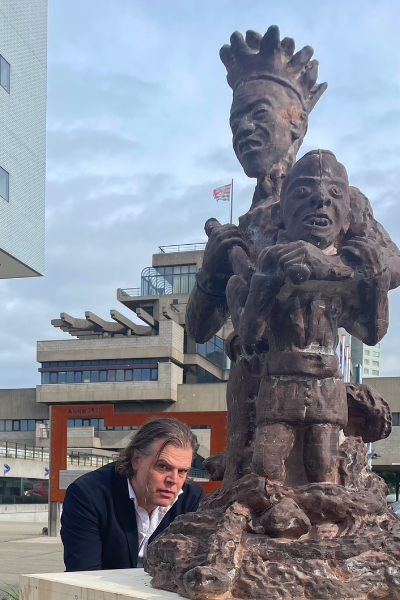
Six sculptures by the art collective of plantation workers CATPC were on display from 9 to 27 October in the center of Terneuzen, the Netherlands, as part of the celebration of the opening of the new sluices. This is a step towards the programme LEARN, DIG, BUILD, leading up to a new arts center in Zeeuws-Vlaanderen that will focus on exchange between global working-class communities. On Saturday 12 October, screenings of the film White Cube were followed by a talk by Renzo Martens to elaborate on the ideas behind the new arts center.
Grant for New Art Platform in Zeeland
The Institute for Human Activities (IHA) receives €250,000 grant from the Province of Zeeland for the project LEARN, DIG, BUILD. IHA’s goal for the coming years is to put their unique working model and expertise for the benefit of structural change in the Netherlands, and more specifically: to build a new art platform in Zeeland: a place for the art of the working class.
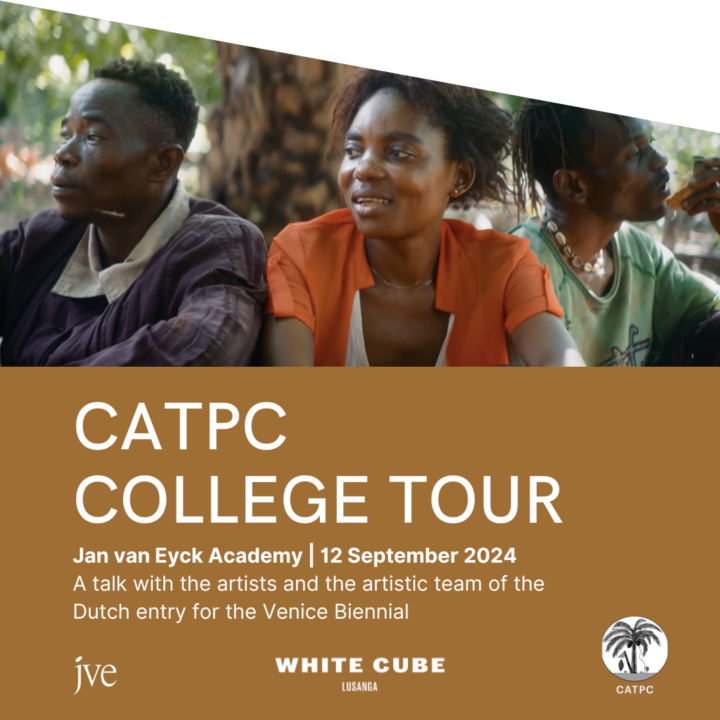
12 September was the start of CATPC’s tour of schools and academies in the Netherlands, where they talked about their experience as Dutch representatives at the Venice Biennale and their long-term practice of getting back their land, history and future through art.
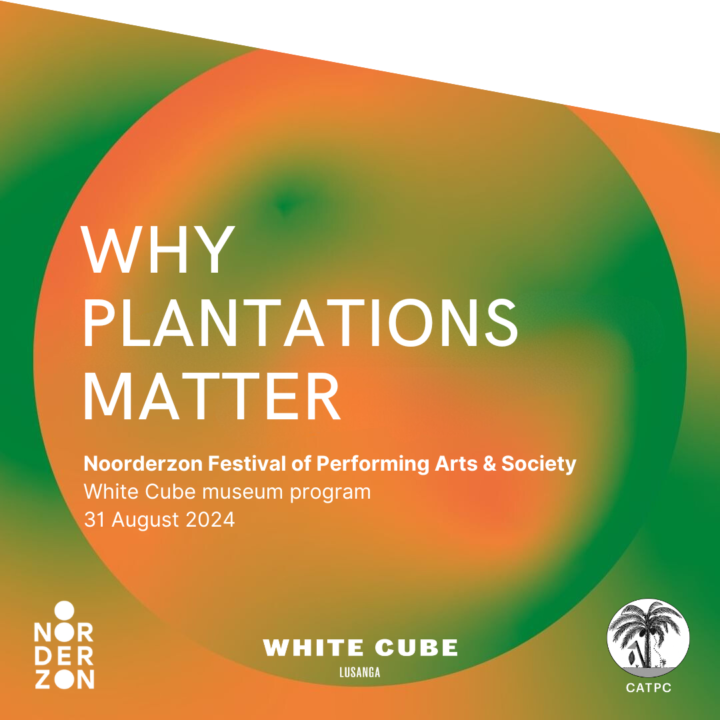
CATPC members Matthieu Kasiama, Mbuku Kimpala and Ced’art Tamasala went to Noorderzon Festival where they gave two talks and an introduction to the screening of the documentary series Plantations and Museums on Saturday 31 August 2024. Renzo Martens had a discussion with art and culture philosopher Thijs Lijster about the value of art and culture on 28 August. One of CATPC’s sculptures was exhibited outside for the duration of the festival.
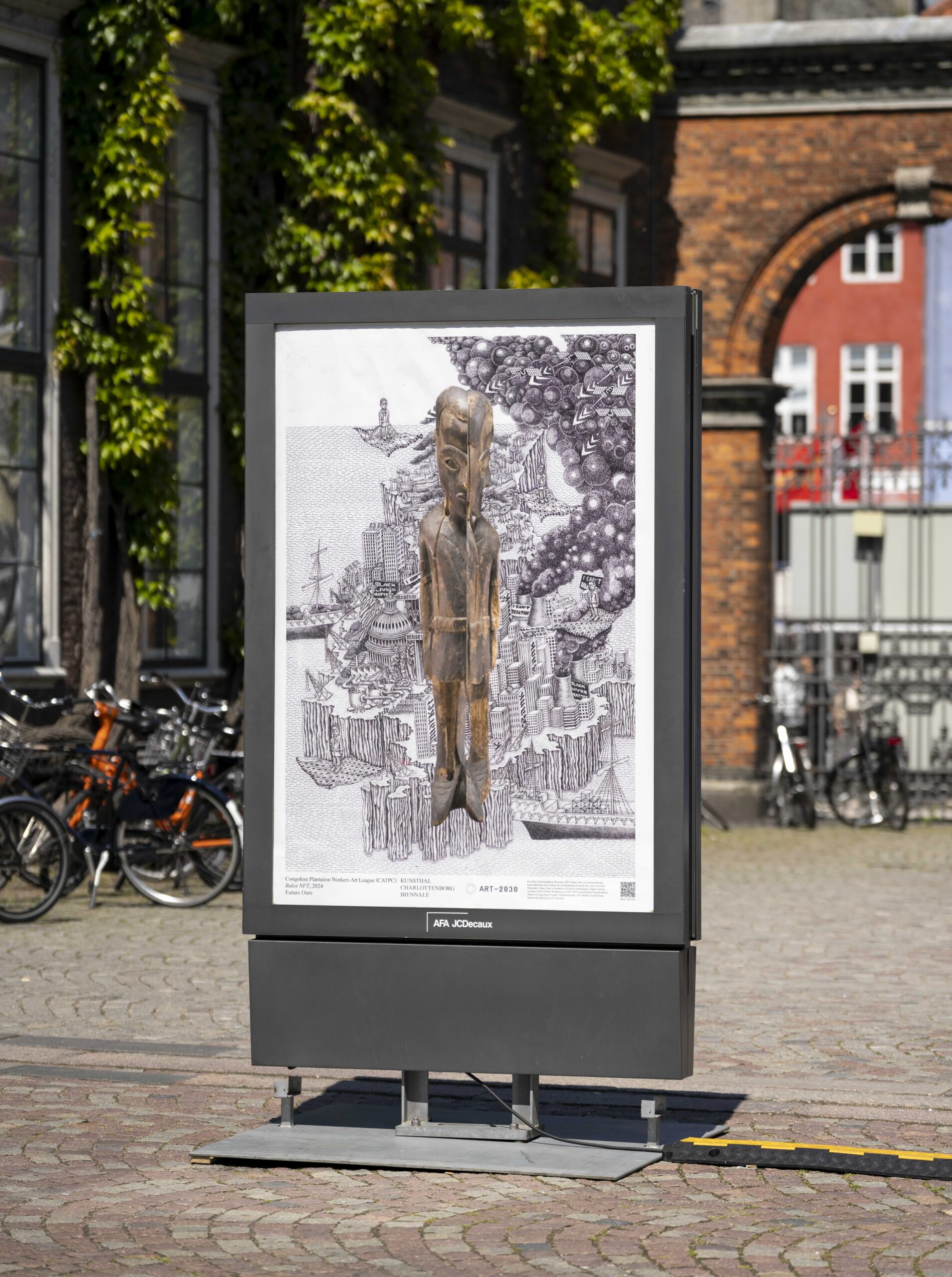
CATPC wins Grand Prize of S+T+ARTS Art Prize Africa ’24 with Balot NFT
The Balot NFT project by CATPC was selected out of 405 submissions from 35 countries to win the Grand Prize of the first STARTS Prize Africa. The award recognizes an innovative model of restitution that uses NFTs to re-collectivize African cultural assets, making them a tool of the decolonization movement.
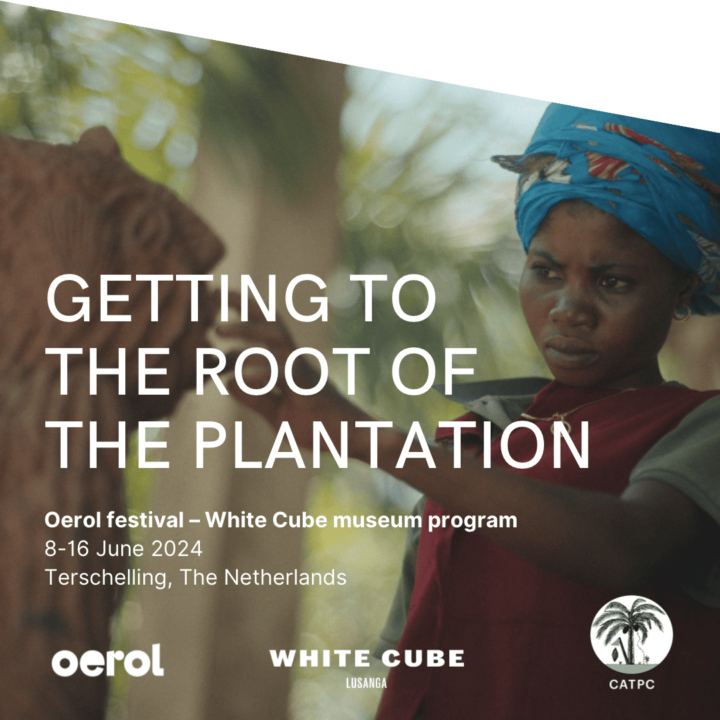
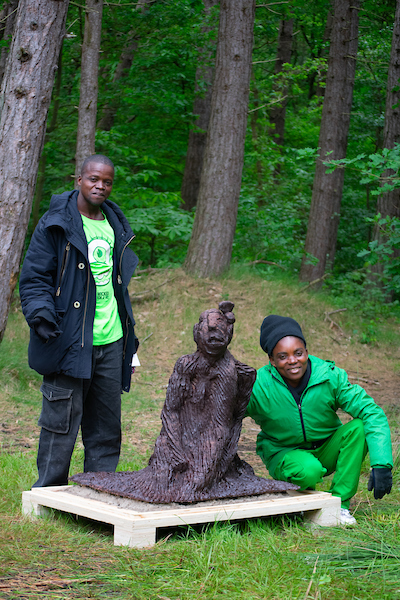
Image: CATPC member Irène Kanga with her sculpture ‘Racines’. Cinematography by Jurgen Lisse.
CATPC is taking part in the expedition program at Oerol, a theatre festival on the island of Terschelling, The Netherlands, with their installation ‘Getting to the Root of the Plantation’. Deep in the forest of the island, two sculptures will be on display: Racines (Irène Kanga / CATPC, 2023) and Crucifixion du Bailleur (Matthieu Kasiama & Ced’art Tamasala / CATPC, 2023).
CATPC member Blaise Mandefu Ayawo passed away
It is with deep sadness that we announce the passing of CATPC member Blaise Mandefu Ayawo. Blaise was 55 years old. He leaves a wife and five young children.
After installing the exhibition in the Dutch Pavilion, Blaise fell ill during the opening week of the 60th La Biennale di Venezia. After a hospitalization of almost two weeks, Blaise passed away. We are grateful to the staff at Ospedale dell’Angelo for their dedicated care.
Blaise Mandefu Ayawo
9/9/1968 – 29/4/2024
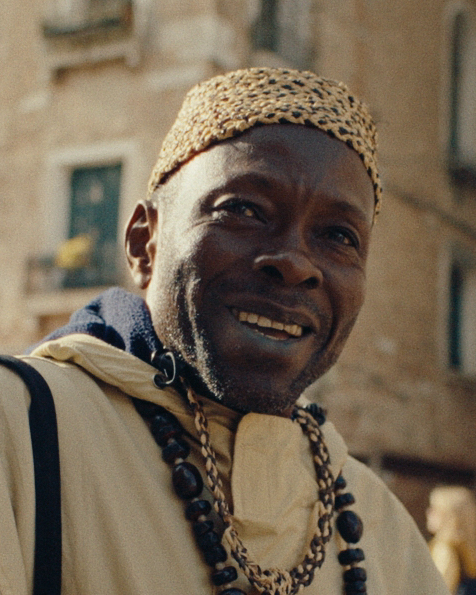
Blaise in Venice, photo: Jurgen Lisse, 2024.
Dutch Pavilion officially opened – Venice Biennale
17 April 2024
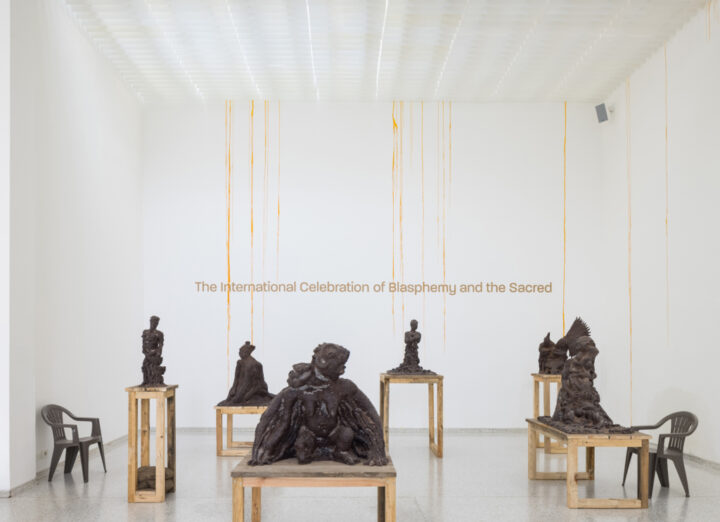
Image: Peter Tijhuis, 2024
The Dutch Pavilion at the 60th International Art Exhibition La Biennale di Venezia was officially opened on Wednesday 17 April by Barbera Wolfsensberger, Director-General of Culture and Media. The Dutch entry, The International Celebration of Blasphemy and The Sacred, is a presentation by Congolese artist collective Cercle d’Art des Travailleurs de Plantation Congolaise (CATPC). Created in collaboration with artist Renzo Martens and curator Hicham Khalidi, it highlights CATPC’s endeavour to reclaim the sacred forests of Lusanga, along with their broader mission of spiritual, ethical and economic reckoning.
Preview Dutch Pavilion – Venice Biennale 2024
27 March 2024
The Congolese artist collective Cercle d’Art des Travailleurs de Plantation Congolaise (CATPC) will represent the Netherlands at the Venice Biennale 2024, supported by artist Renzo Martens and curator Hicham Khalidi. In the run-up to the 60th biennale, opening on 20 April, they gave a preview of their joint plan and elaborated on the story behind their choices in De Balie, Amsterdam.
Ancestral sculpture Balot back in Congo
19 March 2024
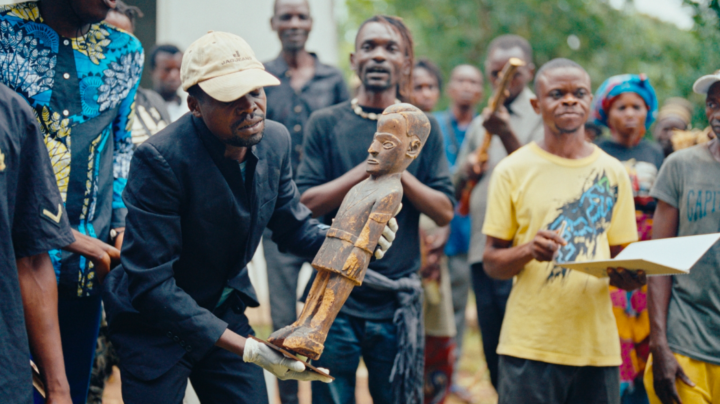
Film still from ‘The Judgement of the White Cube’, CATPC, 2024, image by Jurgen Lisse
Last week, the sculpture Balot arrived in Lusanga, Congo, from the Virginia Museum of Fine Arts (VMFA). On Tuesday 19 March, the artists’ collective Cercle d’Art des Travailleurs de Plantation Congolaise (CATPC) organised a special ceremony to welcome back the sculpture. In anticipation of the Dutch representation at the 60th edition of La Biennale di Venezia, CATPC applied for Balot’s temporary loan. CATPC is collaborating for the Dutch entry with artist Renzo Martens and curator Hicham Khalidi. The sculpture will be on public display at the White Cube in Lusanga from 20 April to 24 November 2024, in parallel with La Biennale di Venezia. At the Dutch pavilion in Venice, Balot will be on view via a live stream.
The Virginia Museum of Fine Arts (VMFA) approves temporary loan request by artist collective CATPC
12 February 2024
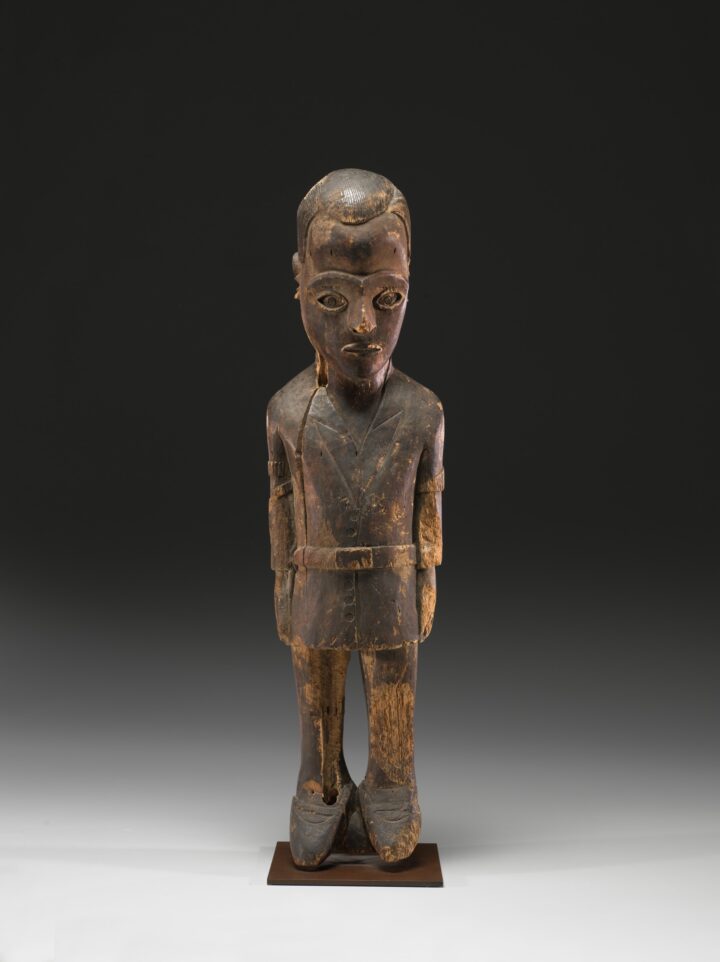
Image: Chief’s or Diviner’s Figure Representing the Belgian Colonial Officer, Maximilien Balot, circa 1931, Unknown artist (Pende, Democratic Republic of the Congo), wood (possibly Alstonia Boonei) with metal repair staples. Virginia Museum of Fine Arts, Aldine S. Hartman Endowment Fund, 2015.3. Photo by Travis Fullerton © 2015 Virginia Museum of Fine Arts.
Historic step forwards for artist collective Cercle d’Art des Travailleurs de Plantation Congolaise (CATPC) and Lusanga (DRC), as Virginia Museum of Fine Arts confirms the loan of the sculpture ‘Balot’, a carved wood ancestral power-figure made in 1931. CATPC requested the temporary loan of Balot in anticipation of the exhibition in the 2024 Dutch National participation at the International Art Exhibition of La Biennale di Venezia in collaboration with Dutch artist Renzo Martens and curator Hicham Khalidi. The sculpture is expected to be on display in Lusanga to the public from April 20 to November 24, 2024, parallel to the Biennale di Venezia.
CATPC and Renzo Martens Dutch Entry for the Venice Biennale 2024
17 April 2023
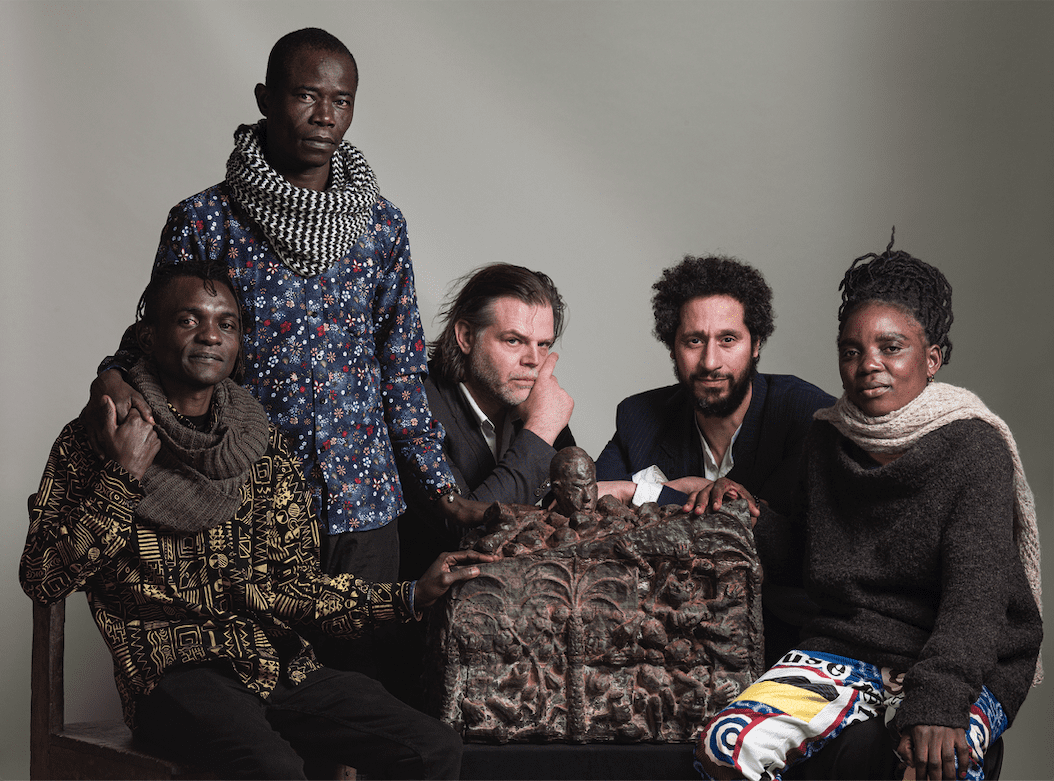 Image, from left to right: Ced’art Tamasala (CATPC), Matthieu Kasiama (CATPC), Renzo Martens, Hicham Khalidi, Mbuku Kimpala (CATPC). Photo: Koos Breukel, 2023
Renzo Martens, Cercle d’Art des Travailleurs de Plantation Congolaise (CATPC) and curator Hicham Khalidi will be providing the Dutch entry for the Venice Biennale 2024. The joint plan will be open to the public from 20 April 2024 at the Rietveld Pavilion in Venice and simultaneously at the White Cube in Lusanga, the Democratic Republic of Congo (DRC). This Dutch entry will therefore consist of two presentations that are directly mirrored and connected.
31 August – 3 September 2023
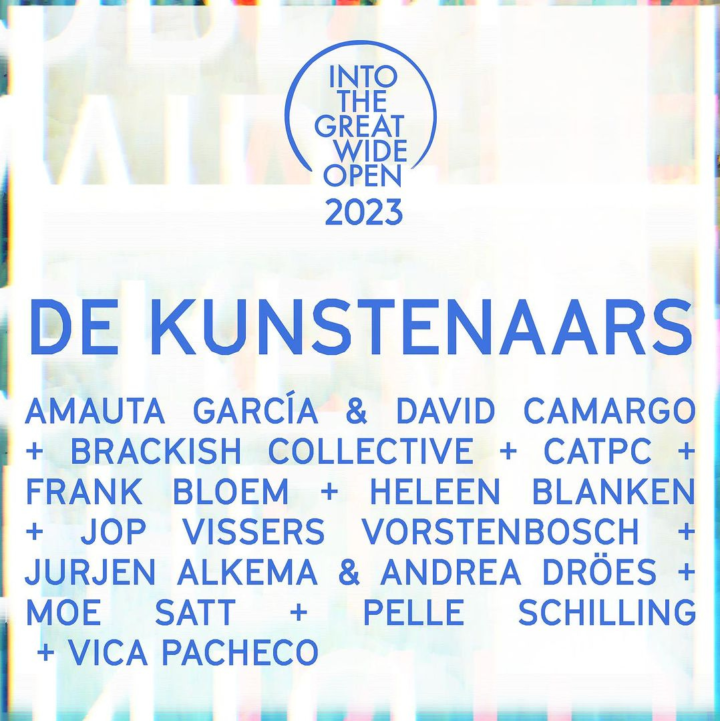
Several works by CATPC and Renzo Martens will be on view as part of Into the Great Wide Open’s festival art program.
The installation Why Plantations Matter will be spread out over the forest of Vlieland and in the Tromp’s Huys museum. In the forest, you will find Athanas Kindendie / CATPC’s Plantation Monoculture – a sculpture which criticizes the monoculture of palm plantations that took a century-long grip on the land and completely depleted it – and the Balot NFT. In the museum, the series Plantations and Museums will be on view.
Current Vacancies at Human Activities
1 September 2023
We are looking for:
Medewerker Financiën, Subsidies en Bureau (filled)
Intern Projects and Exhibitions (filled)
7 June 2023
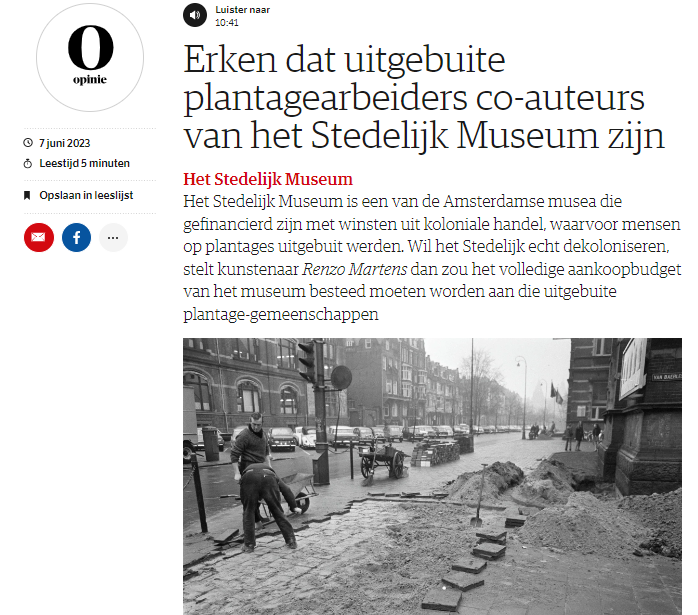
Image: Screenshot of Renzo Martens’ publication on NRC, including “On the loose” by Jan Dibbets (1969), photo: Stedelijk Museum Amsterdam
On 7 June 2023, Renzo Martens’ article about the connection between plantation workers and the Stedelijk Museum Amsterdam was published. In the publication, Martens begins by presenting the work of Dutch artist Jan Dibbets who, in 1969, dug out the four corners of the Stedelijk Museum to expose its foundations and question the existence of the museum. Fifty years later, while still speculating on the unrestrained continuation of plantation labor, the Stedelijk has not yet given credit to the plantation workers who contributed to the construction of the museum. Martens writes:
“The truth is that plantation workers are the co-authors of every single wall, every beam of light and every line of perspective.”
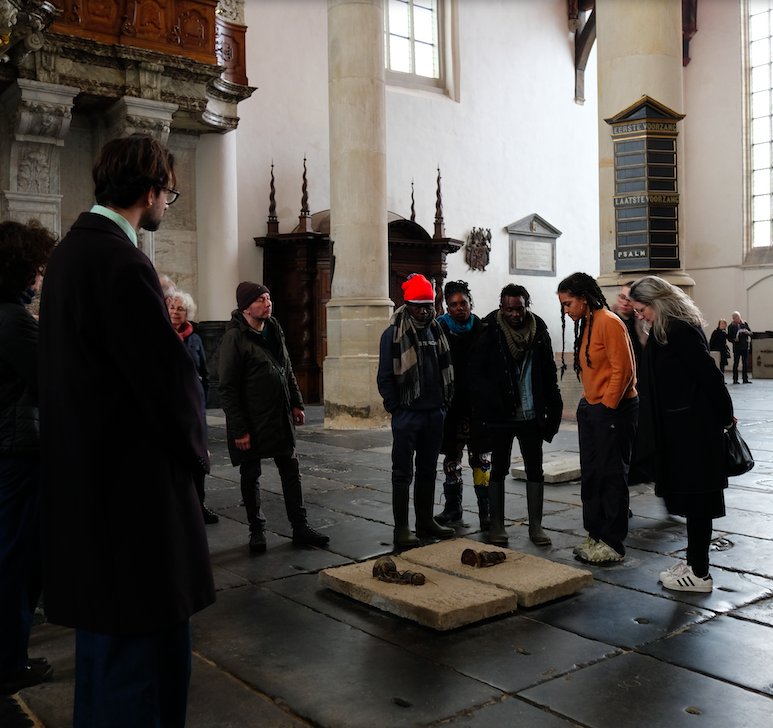
CATPC Walk & Talk at the Oude Kerk
19 March 2023
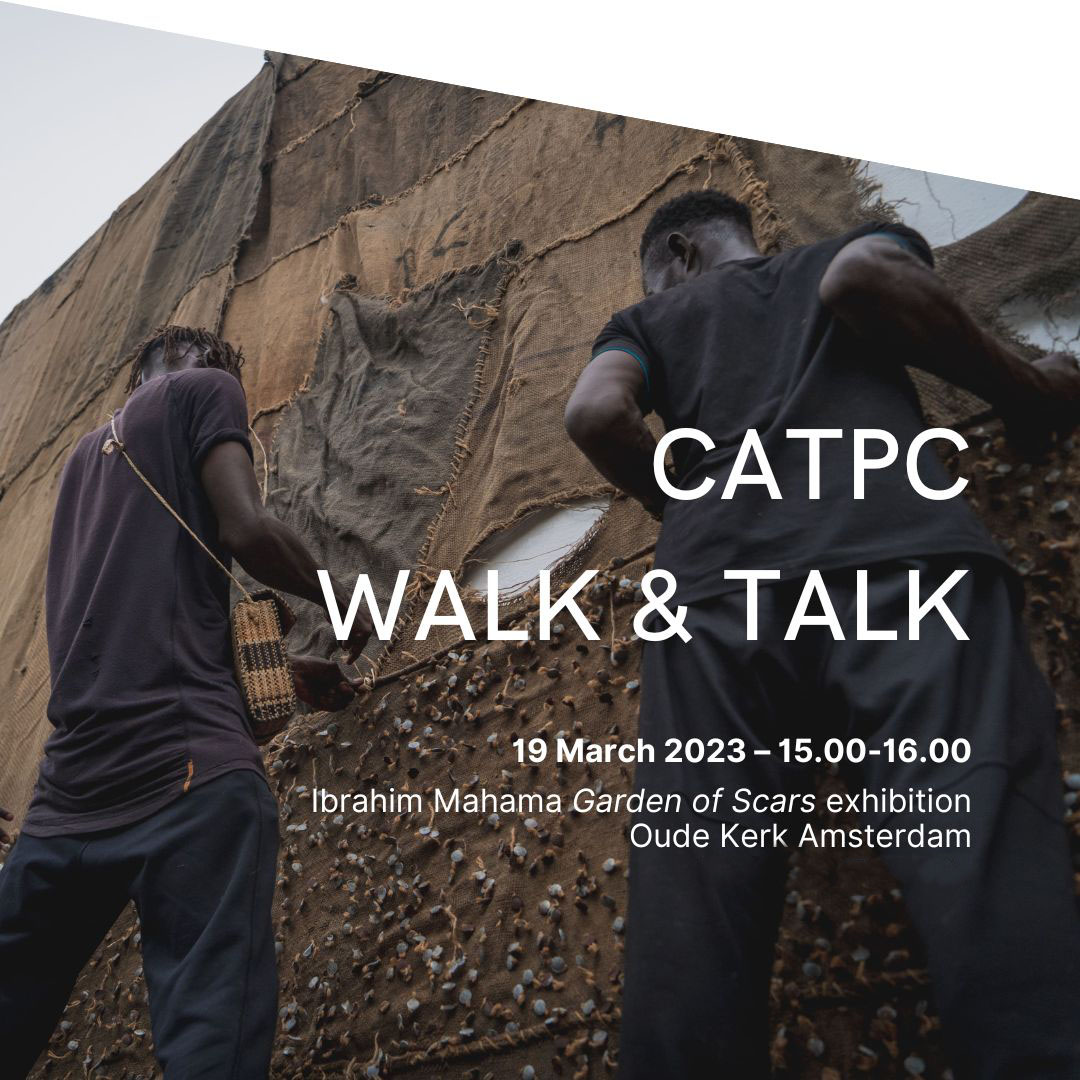
Image: Ced’art Tamasala and Matthieu Kasiama (CATPC) installing Ibrahim Mahama’s “Judgment of the White Cube” solo show at the White Cube in Lusanga, photo: Dareck Tuba, 2022
Join the Congolese Plantation Workers Art League CATPC as they reflect upon last year’s Ibrahim Mahama show Judgment of the White Cube at their museum in the middle of a plantation, the White Cube Lusanga, from the site of Mahama’s latest exhibition Garden of Scars at the Oude Kerk, Amsterdam.