Learn, Dig, Build.
Art that gives back agency
Human Activities believes that art about inequality must actually reduce inequality: not only symbolically, but in real, material terms. Our education program is built on that conviction: it connects the world of the plantation to Dutch classrooms, museums, and communities.
For more than ten years, Institute for Human Activities has worked with CATPC, an artist collective living and working on a former Unilever plantation in Lusanga, DRC, developing a method through which one of the most marginalised communities on earth uses art to reclaim its land, its capital, and its political position. The time has come to bring the lessons of Lusanga to the Netherlands.
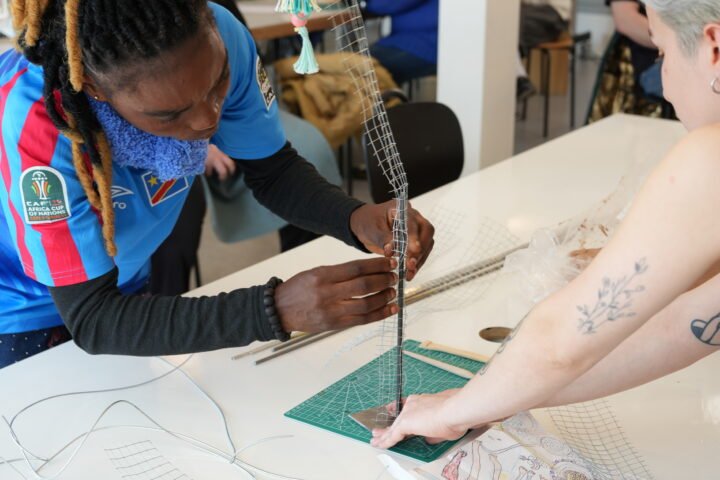
Workshop by CATPC member Mbuku Kimpala at Wereldmuseum Rotterdam. Photo: Martina Brienza.
Learn, Dig, Build: our approach
Our education programme is called Learn, Dig, Build and it runs through everything we do in schools, museums, festivals, and communities.
Learn. First we listen to the plantation. We learn about the impact of colonial history on the communities who produce raw materials such as cocoa and palm oil, and about what art can undo. This method grew out of CATPC’s own artistic practice: at the heart of the Congolese plantation system, the local community, together with Institute for Human Activities, developed a methodology that puts artistic means to work as an instrument for restitution for social, land, gender, and climate justice. In the Netherlands, this means introducing students, educators, and audiences to CATPC’s own history: how a community of plantation workers, against all odds, took the power to reclaim their history, land and future through making art.
Dig. Then we dig into the local conditions of Dutch communities who also feel unheard. We draw out the parallels between plantation workers in Lusanga and people in the Netherlands who experience social and economic inequality, and who feel disconnected from art and culture: from dockworkers in the cocoa harbour of Amsterdam to residents of Zeeuws-Vlaanderen. Young people who take part in our schools programme are invited to take this same step: researching their own environment, its history, and what it needs for the future.
Build. Finally, we build new infrastructure for a different kind of art. We take education out of the museum and into schools, festivals, harbours, and fields. We invite young people not as an audience, but as participants, makers, and stakeholders. They will collectively establish a new art platform: White Cube Zeeuws-Vlaanderen. Our goal is not to teach students about inequality: it is to help them experience that they have the right and the power to reshape their own reality through art.
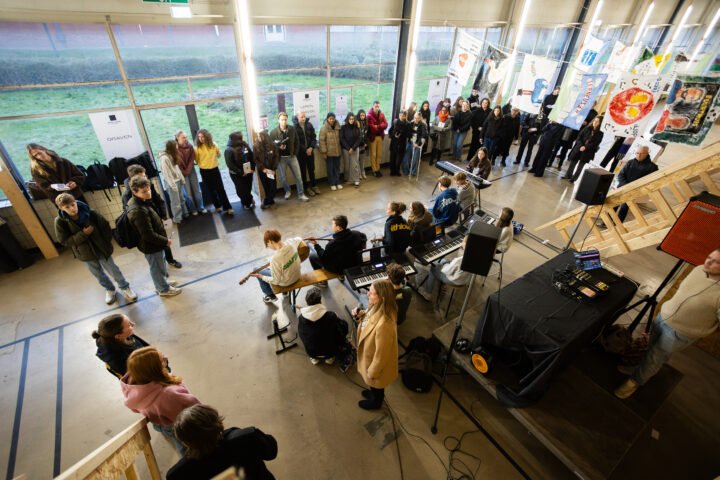
Opening exhibition Leren, Graven, Bouwen. at Lodewijk College in Zeeuws-Vlaanderen. Photo: Kelly Thans.
Now You Know: primary & high school program
Now You Know is an education programme that activates young people across the Netherlands, from VMBO students to art academy students. Its core premise: a marginalised community in Congo, against all odds, reclaimed its right to art from the economic and cultural elites who had stood above them for centuries. What can Dutch students learn from that?
Students take part in a series of workshops with CATPC members and other artists and art educators, gaining first-hand experience that they too have the right – and the means – to shape their own world through art. In secondary schools, the workshops are built around the citizenship curriculum (burgerschap): students examine questions of inequality, participation, and democratic agency through CATPC’s own history, then apply that lens to their own environment and position in society. The programme runs primarily with school communities in several regions in the Netherlands. Students join CATPC at related activities, such as exhibitions at partner museums.
Now You Know has already been implemented at CBK Zuidoost and different schools in Zeeuws-Vlaanderen. Schools can use this education programme both independently and with help of Human Activities.
The lesson package is developed together with Nederland Wordt Beter, together with the education departments of the Van Abbemuseum.
The Land of Chocolate Sprinkles
This spring, H’ART Museum in Amsterdam presents Het Land van Hagelslag. Samen Bouwen aan een nieuwe wereld (The Land of Chocolate Sprinkles. Building a New World Together), 22 May – 8 November 2026. This solo exhibition of CATPC is a meeting between the world of Lusanga and the world of Amsterdam, between people who produce and people who consume, between a past that still resonates and a future that is already being built. CATPC invites visitors to turn a new page together and look toward a more just future.
At the heart of the exhibition stands the kinzonzi: a communal work table where visitors are invited to shape their own response to the work of CATPC. How do land and people find balance again, and how do we build a new world together?
Human Activities has developed an education programme to accompany the exhibition, and trained the museum educators of the museum to carry out this program. So far, we worked together during the H’ART exhibition with primary schools, high schools, academic institutions, regular visitors of the museums, Stichting Vooruit and Openbare Bibliotheek Amsterdam.
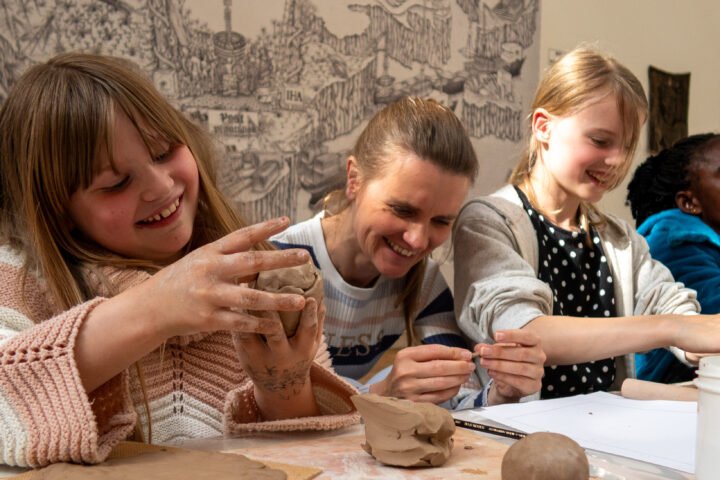
Clay Workshop at H’ART Museum. Photo: Emiel Bavelaar.
Clay workshops at the kinzonzi
At the kinzonzi worktable, visitors take part in clay workshops that follow CATPC’s own way of working. CATPC’s artists start every sculpture the same way: modelling it by hand from the soil of the plantation, drawing out an idea (muzindu) until it becomes a sculpture (kukungika). Only afterwards are these sculptures 3D-scanned and reproduced in the plantation’s own raw materials — cocoa, palm oil, and sugar.
In the workshop, visitors model their own response in clay at the kinzonzi table: to the questions CATPC poses about land, history, and the future — Disolo (history), Ntoto (land), and Mbasi (future). The clay works made during these sessions become part of the exhibition itself, and a selection travels on to CATPC’s White Cube in Lusanga for the second part of the exhibition in November 2026. Sessions attended by members of CATPC are especially valuable, since visitors shape their own sculpture alongside the artists who developed the method.
White Cube Zeeuws-Vlaanderen
In 2017, Human Activities and CATPC built a White Cube in Lusanga, designed by OMA. The White Cube was brought back to the very place whose wealth historically financed Western art institutions.
We are planning to build a second White Cube in Zeeuws-Vlaanderen in the most marginalised region of Zeeland, next to the largest nitrogen-emitting factory in the Netherlands, wedged between the nuclear plants of Borsele and Doel, in a region where it has proven difficult to get young people to stay. Plantation workers from Congo and international artists will work alongside local Zeeland communities: carnival associations, amateur art clubs, asylum seekers, farmers to make a new kind of art: one that generates real social, economic, and ecological change.
Building the second White Cube is a process of co-creation. Human Activities involves citizens in general, and local artists and students in particular. Co-creation sessions have already begun through the launch of the education programme at Nesse, Lodewijk College, and Basisschool De Driesprong:
- Basisschool De Driesprong ran a six-part workshop series on CATPC and the themes of land, history, and the future. Pupils aged 9 to 12 researched their own surroundings (Hoek) and made artworks about what their environment needs for the future, presented in an exhibition at the school for parents and fellow pupils.
- Lodewijk College took part in a dedicated project week and an ongoing collaboration, Learn, Dig, Build – Claim Your Space: a lesson package based on the project week, adapted for classroom use, in which students research their own surroundings and history and consider what their environment needs for the future. The package can also be adapted to other regions and communities.
- A Junior Curator programme is being developed for young people to gain hands-on curatorial experience within the White Cube Zeeland programme.
Echoes of the Day
In 2025, students of Lodewijk College created new work as part of a long-term collaboration with Human Activities, exhibiting the results in both Terneuzen and the White Cube in Lusanga. The students from Terneuzen met the members of CATPC, an artist collective living and working on the plantation in Lusanga, and connected these conversations to their own experience. Over the course of the year, the students discovered how a community in Lusanga reclaimed its land through art, before starting to make work of their own.
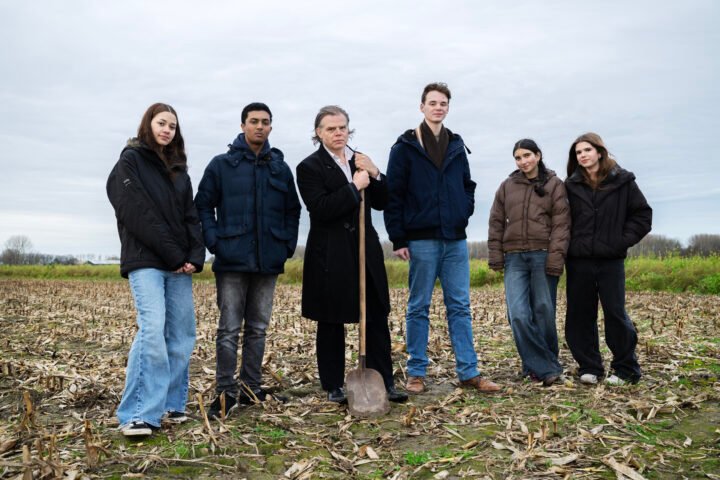
Renzo Martens and students of Lodewijk College in Zeeuws-Vlaanderen. Photo: Sanne de Wilde
Learn, Dig, Build at K21 Düsseldorf
In the framework of the exhibition Land and Soil. How We Live Together at K21 (Kunstsammlung Nordrhein-Westfalen), Düsseldorf, on view until 19 April 2026, CATPC took the Learn, Dig, Build method abroad for the first time, with a conference and an educational programme developed together with K21 and Human Activities, and supported by the Mondriaan Fund.
Conference. On 29 November 2025, CATPC hosted the conference Learn, Dig, Build, engaging with some of the most forward-thinking artists of this generation to discuss the relationship between land, art, and the future. The conference centred CATPC’s position as a community of plantation workers: speaking from their own lived experience, they reflected together with their guests on land, NFTs, and regeneration, and on how these other practices resonate with or amplify CATPC’s own regenerative work. The programme followed the same three-part structure:
- Learn — CATPC in conversation with Johannes Büttner, Renzo Martens, and Alex Wissel.
- Dig — CATPC in conversation with Havîn Al-Sîndy, Nir Evron, and Christopher Kulendran Thomas.
- Build — CATPC in conversation with Simon Denny, Paul Kolling (terra0), and JP Raether.
The conference was hosted by CATPC together with Kolja Reichert, Chief Curator of K21.
Educational programme. Alongside the conference, CATPC developed an extensive educational programme for young visitors to K21. Following CATPC’s own example, students learn how they too can use art to claim ownership over their own history, land, and future. Students took part in workshops with CATPC members Matthieu Kasiama, Mbuku Kimpala, and Ced’art Tamasala, including dedicated sessions with the local Lycée Français and the Werk:Klub workshop for 16- to 26-year-olds. For the duration of the exhibition, guided tours introduce schoolchildren to CATPC’s work and to the Learn, Dig, Build method.
Read more at humanactivities.org/en/learn-dig-build.
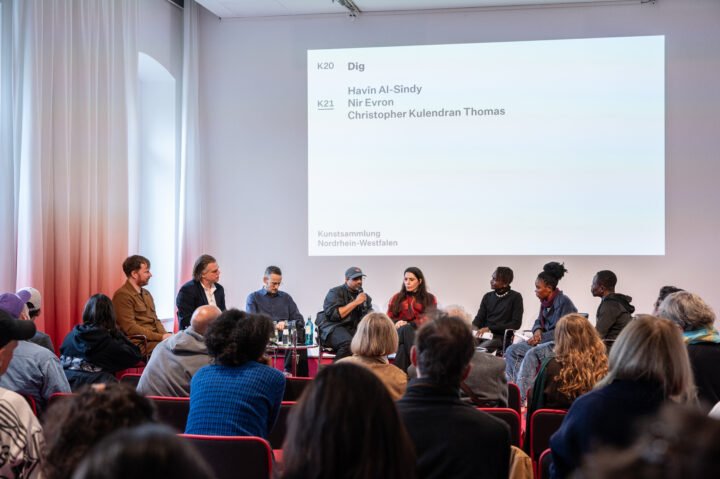
Learn, Dig, Build at K21 Düsseldorf. Photo: Linda Inconi.
Ecole Luyalu: research and development
Ecole Luyalu is a long-running educational initiative growing directly out of CATPC’s own artistic practice: an autonomous, informal school in Lusanga. At the heart of the Congolese plantation system, the community has, together with Human Activities, developed a methodology that puts artistic means to work as an instrument for restitution for social, land, gender, and climate justice.
Ecole Luyalu works in partnership with SCCA in Tamale, Ghana, and BlaxTARLINES in Kumasi, Ghana, functioning as a shared model for building and exchanging knowledge, so that the community can establish international collaborations and alliances on its own terms. It develops tools that local communities can use to regain control over their culture, their art, their land, and their society: including regenerative art practices, tools for collection interventions, and activist strategies for restitution and land recovery.
Book a session
Our education packages are open and free to use on your own occasion. If you would like more information about our education packages, or help implementing them in your lessons, you can contact us. We work with schools, museums, and cultural institutions across the Netherlands. All sessions are tailored to your group, age range, and curriculum. We currently work with schools in the regions of Eindhoven/Den Bosch, Zeeland, and Amsterdam Noord and Zuidoost.
Contact our Education Coordinator Oskar van der Werff: oskar[@]humanactivities.org